Back to portfolio
Job aid
Healthcare
Infection Prevention for Ultrasound-Guided Peripheral/Intravenous (IV) Catheter Insertion
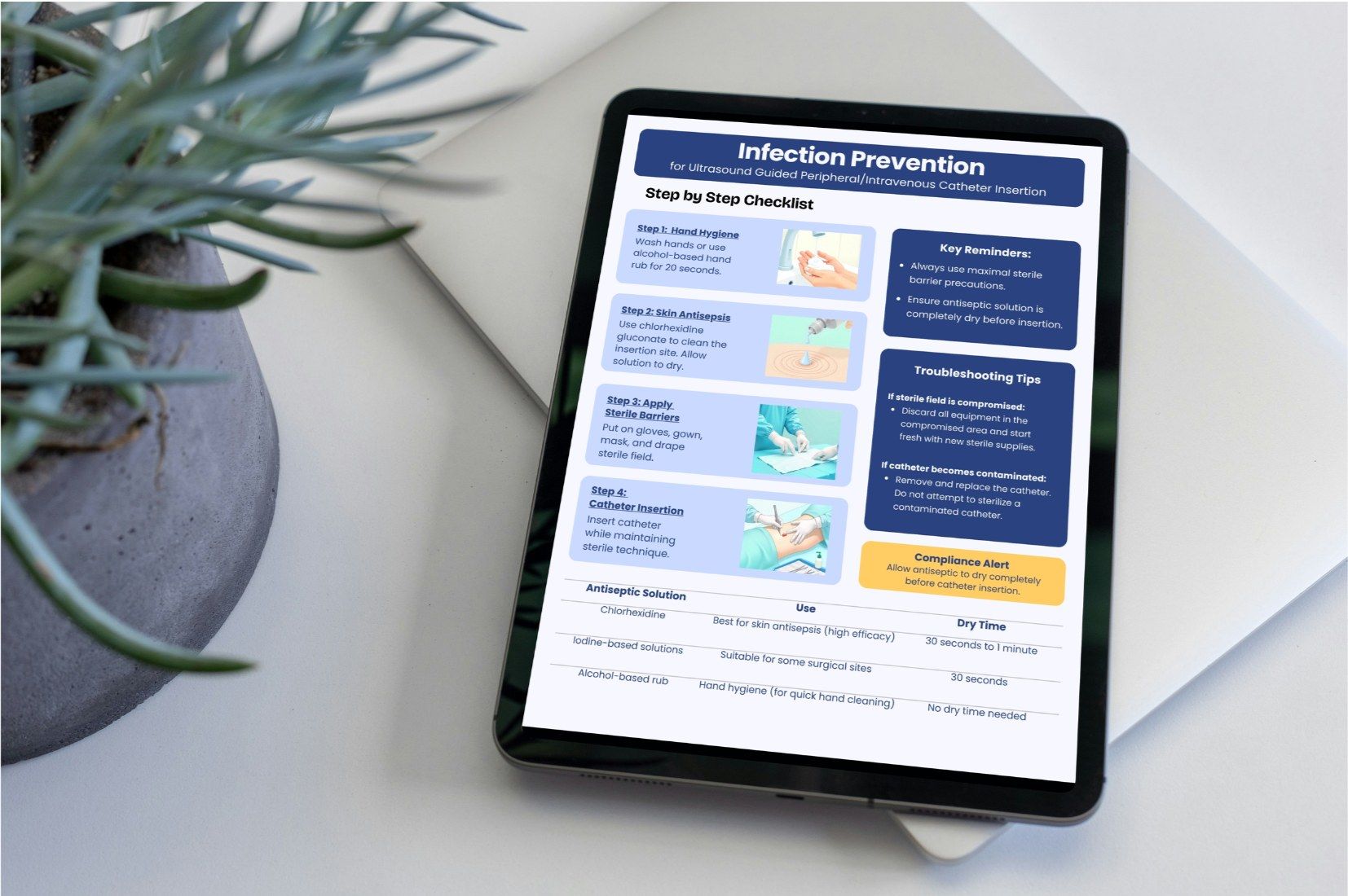
A step-by-step job aid that helps newly hired nurses maintain sterile technique during ultrasound-guided IV catheter insertion.
- Audience
- Newly hired nurses
- Responsibilities
- Instructional design, course development, graphic and visual design, prototyping
- Tools used
- Canva, Freepik Pikaso
The problem
Peripheral IV insertion is a routine hospital procedure, yet catheter-related infections (CRIs) remain a persistent risk. Many trace back to three breaks in sterile technique:
- Antiseptic not drying fully. Chlorhexidine isn’t always allowed to dry before insertion, which reduces its effectiveness.
- Compromised sterile barriers. Improper use of gloves, gowns, masks or drapes can breach the sterile field.
- No standard process. Without a step-by-step guide, practice varies from nurse to nurse.
Newly hired nurses, still building their habits, are especially prone to rushing or skipping these steps. The result is more complications, longer hospital stays and higher costs.
The solution
Nurses need the right steps at the moment of insertion, not buried in a policy manual. I designed a one-page, step-by-step job aid that addresses each cause:
- Dry time. A Compliance Alert and a quick-reference table of dry times for each antiseptic.
- Sterile barriers. An illustrated four-step checklist, from hand hygiene through insertion, with visuals I created in Freepik Pikaso.
- A standard process. One consistent checklist for every nurse, plus troubleshooting tips for a compromised sterile field or a contaminated catheter.
The job aid can also serve as a reference for compliance audits.